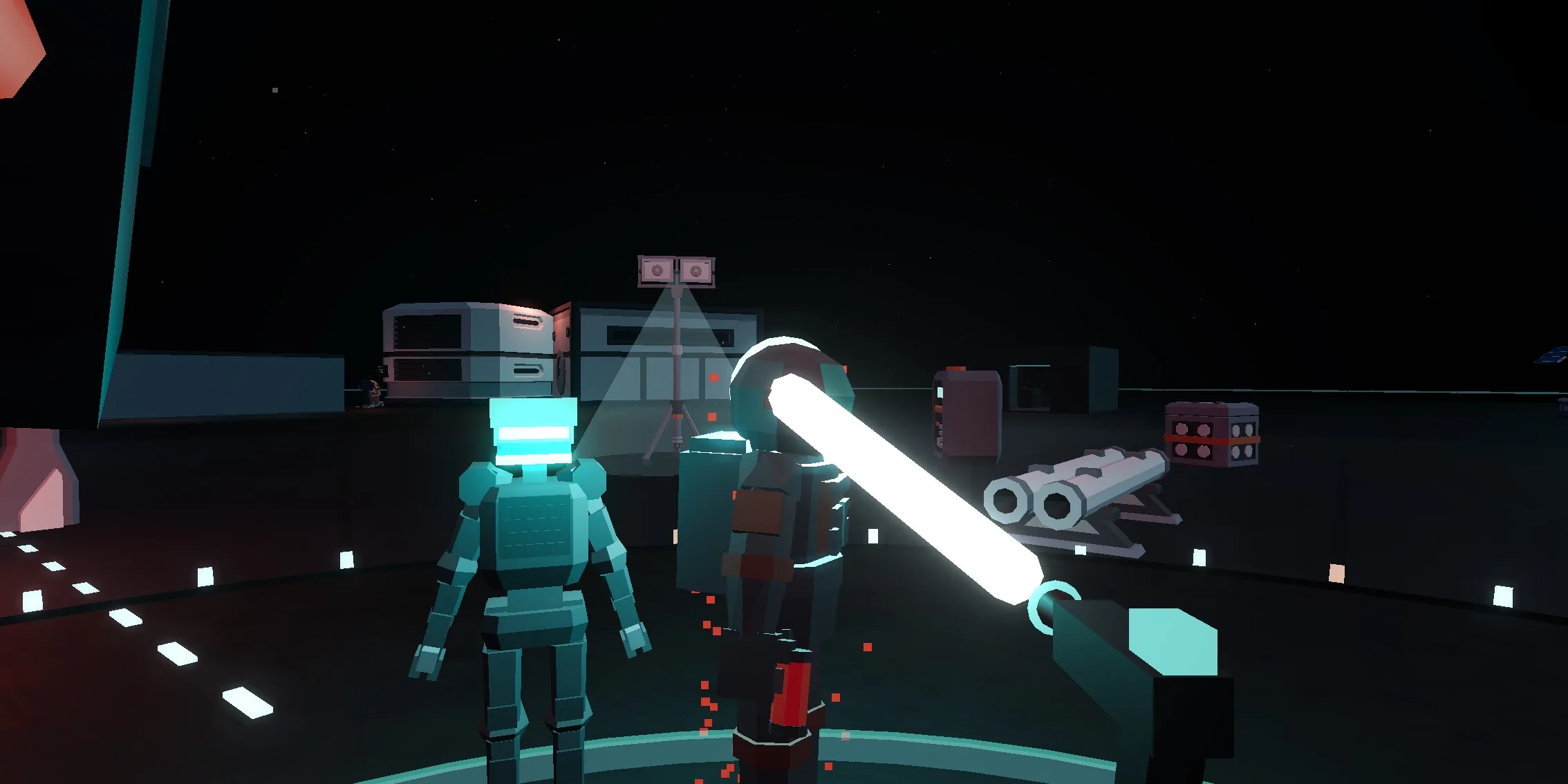
The sending is the mechanic the game is built to arrive at, and it is also the one part of the game that explains its rules to you while you are busy failing them. This page exists so that a player who is stuck can read those rules somewhere calm. Everything above the shutter at the bottom is mechanics, and none of it tells you how the game ends.
The rule of the ship is that the door can only be closed from the inside, by a living voice sending the crossing back, inverted, in order, with no machine anywhere in the loop. That last clause is what makes this a game rather than a button. It cannot be automated, and it cannot be delegated, which means somebody has to stand in the most dangerous place aboard the vessel and finish a sentence.
You start it by standing on the platform under the core and using it. The prompt says so directly. From that moment the game gives you a progress bar labelled THE SENDING along the top of the screen, three marks of air in the lower left, and one objective line: hold the platform, and keep them off the ring.
I do not step off this dais. Whatever comes across that ring, I do not step off. That is the whole plan. RYN, AS THE SENDING BEGINS
There are two numbers that matter and the game shows you both of them, although it never explains either.
Seventy-two seconds of work inside a hundred and seventy seconds of budget leaves you very nearly a hundred seconds of slack, and that slack is exactly what the interruptions below are priced against. The budget was chosen so that a player who works finishes comfortably and a player who stands still does not finish at all.
Roughly the first half-minute is spent alone. The crew converge from wherever their patrol routes happened to have them, which can be fifty metres away, so the reading opens quietly and then stops being quiet.
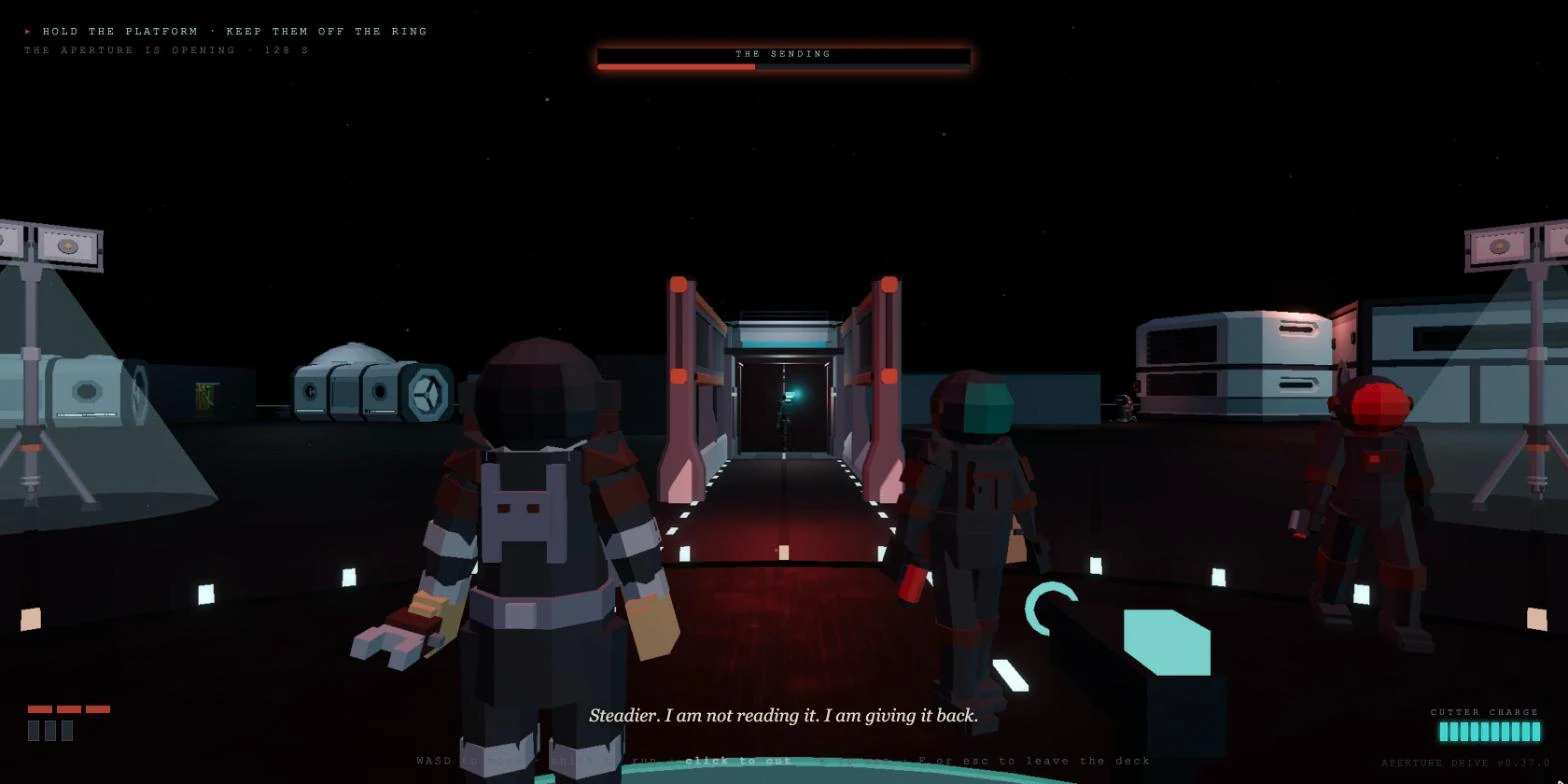
The Returned converge on the platform. They are not attacking you. They are maintaining a door that has been opened, and you are standing in it, and the game has been telling you that they maintain rather than hunt since Act II.
What they do when they arrive is precise, and it is worth understanding because the whole of the fight follows from it. Each of them walks to a fixed slot on the rim of the platform, two and a half metres out from the centre, and stands there. They press the edge. They do not walk into the middle.
Any crew member standing within three metres of the centre of the platform is pressure, and pressure breaks the reading. A rim slot at two and a half metres is comfortably inside that radius, which means one arrival is enough to start the problem.
Four continuous seconds of pressure and the line goes. Ryn says she has lost it and has to go back, and the current stanza is set back by six seconds. It costs you six seconds off the line you were on, not the whole line, which is the difference between an interruption and a wall. Immediately afterwards you get a three second grace window in which pressure cannot break it again, and that window is your opportunity rather than a mercy: it is what you use to clear the ring.
If the pressure lets up before the four seconds are out, the falter timer winds back down again at the same rate. Partial credit is real here. Getting one of them off the rim two seconds in genuinely helps.
Standing on the platform, you are not in bite range of a crew member who is holding a rim slot. This is deliberate and it is the single most important thing to know about the encounter: obeying the instruction and standing on the platform is safe from contact, and only costs you time. If one of them does close to within a metre and a half of you, it takes a mark of your air, and it can only do that once every five seconds.
Everywhere else in the game the cutter staggers a crew member for ten to fourteen seconds and can never do anything worse than that, and the game is emphatic that this limit is the point.
During the sending, and only during the sending, that changes. A crew member caught in the beam comes apart into a settling cloud, and does not get up. A cloud is not pressure, so a rim slot that has been cleared this way stays cleared, which means holding the platform is a task you can actually finish rather than a rotation you have to sustain until the clock runs out.
There are five of them and the beam reaches fourteen metres, so from the centre of the platform every slot on the rim is well inside range. You do not have to move. You have to turn, and pick, and be patient.
It came apart. It did not fall. It stopped being there. RYN, THE FIRST TIME IT HAPPENS
What becomes of the dust is on the endings page, behind its gate. It is not what you will assume while it is happening.
Twice during the reading the Passenger crosses the drive bay. It happens on the third stanza and on the sixth, at the same points every time, so it is a rhythm rather than a surprise after your first attempt.
You get five seconds of warning and the warning is unmistakable. The screen takes a red vignette from the edges inward, the camera begins rolling slowly on its own, the objective line changes to say that it is leaning and that you should stand on the platform, and a sting plays.
The shelter is the platform, out to three point four metres from its centre. That is a slightly wider circle than the pressure radius, so if you are anywhere on the marked ring at all you are safe. The reason is stated once in the design and never repeated in the game: it will not come near its own way out.
Two crossings, both survivable by standing still in the place the game has been telling you to stand since the first line of the act.
Three marks, shown lower left, and they only appear while the sending is running. You lose one to a contact and one to being caught out in the open by a crossing.
There is one way back. Twenty seconds without taking any damage at all returns a single mark, and then the twenty second clock starts again. It is slow on purpose. It is slow enough that it can never outrun a crew that has reached you, and generous enough that a bad opening minute is not fatal to a careful rest of the run.
They arrive at the same place from opposite directions.
The second one is the more likely of the two by a wide margin, and it is the one that catches careful players. A player who never clears the rim is not being hurt at all. They are simply being interrupted every four seconds, and the arithmetic quietly stops working: measured against the crew’s convergence, that player stalls somewhere around the fifth stanza of eight when the deadline expires. A player who cuts finishes at about seventy seconds without ever being touched.
Both failures produce the same end card, which is named and reproduced on the endings page.
In order, and none of this is a trick.
The stanzas are subtitled in glyphs and never in words. They are drawn from the same rune set the sibling game used for its own reading, and that reuse is canon rather than a coincidence: the far side of the Aperture and the ground under Blackpine Hollow are not two different places.
This wiki does not transcribe them, on the same grounds that the game refuses to translate them. Between the glyph lines Ryn says five things in her own voice across the eight stanzas, and those five lines are the only account of what reading it feels like that you will ever get.
The eighth stanza is shorter than the seven before it, and Ryn tells you why before she reads it.
When it lands, every crew member stops in the middle of a step. Not because they have been defeated, and not because you did anything to them. The instruction they were following has been withdrawn, and there is nothing left telling them what to do.
What they do next, and what becomes of the ones you cut, is the last three minutes of the game and it is on the endings page, behind the heavy gate where it belongs.