The drive is the first thing you see, before the title has finished fading, and it is the last room the game takes you to. Everything on this page is visible from Act I, so none of it is gated. What the drive is eventually used for is on the sending page.
The Aperture is a fold drive, and the distinction the game draws about it is the whole of its cosmology. It does not travel to a place. It travels through something, and the something is not empty.
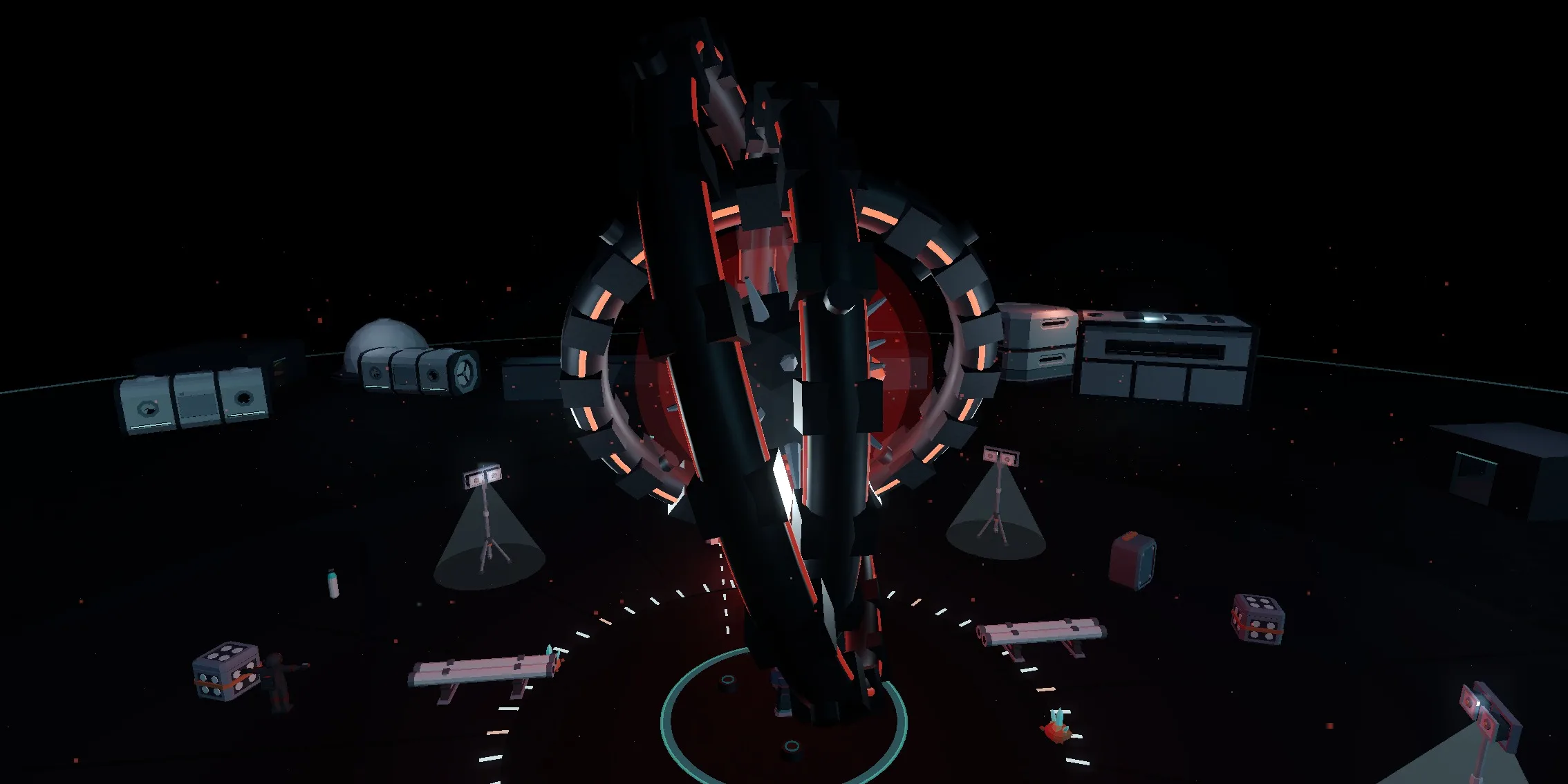
Physically it is two pieces. There is the gate at the southern edge of the bay, which is the ring you would recognise as a drive if you had ever seen one, standing eleven metres tall at (0, -21.5). And there is the core and its gimbal, suspended over the pit at the centre of the ship, which is what actually turns.
The gate is the door and the core is the mechanism, and the game is careful never to render an opening in either of them. There is no portal effect anywhere in this game. What there is instead is a circle inside the gate whose interior is simply darker than the room around it, and which grows more opaque as the drive comes up to speed. It is a hole in the sense that a hole is an absence rather than a picture.
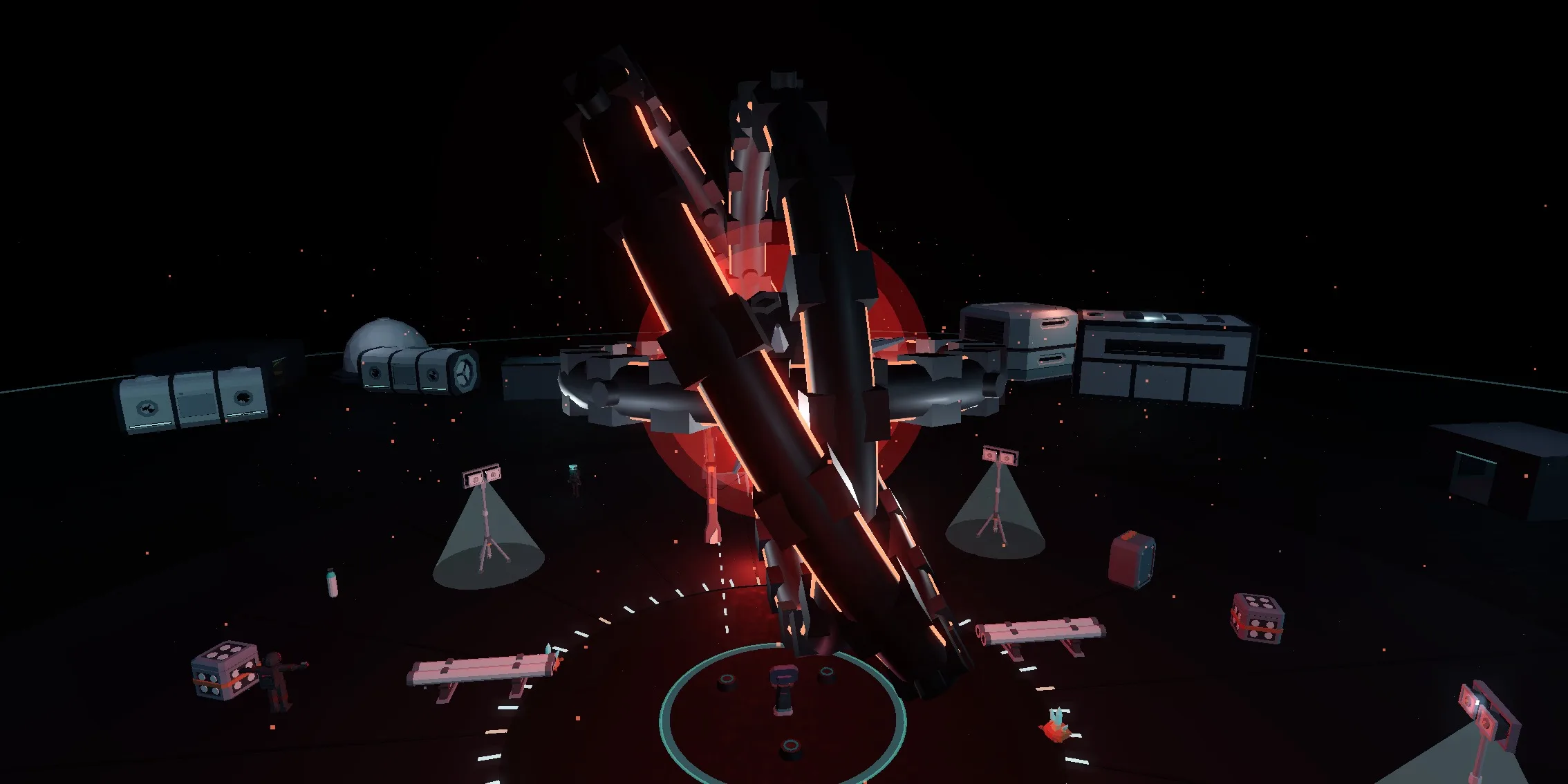
A spiked sphere about six metres across, hanging just under ten metres above the deck, with twenty-six spikes and six lens ports set into a hull that has been finished in charcoal. The lenses are the only part of it that emits, and they emit the wrong red, which is the red the rest of the ship does not use for anything except the crew and the reactor.
It is wrapped in two additive halo shells, one just outside its own radius and one just inside, which is why the light around it reads as a field rather than as a lamp. It rotates on its own vertical axis all the time, slowly when the drive is dormant and three or four times faster once the rings are up. When the drive gets hot it throws arcs, drawn as eight point line segments leaping between one spike and another.
Three gimbal rings surround the core, and they are the best piece of information design in the game because they are readable from anywhere in the bay without a single word of interface.
| RING | RADIUS | TURNS ABOUT | DIRECTION |
|---|---|---|---|
| Inner | 4.9 m | the x axis, upright and facing you | one way, and the fastest of the three |
| Middle | 6.3 m | the z axis, tilted a quarter turn out of the first | the other way |
| Outer | 7.7 m | the y axis, tilted again | the first way, and the slowest |
They counter-rotate, they are mutually perpendicular, and each one also carries a very slow precession on a second axis so that the machine never settles into a pattern your eye can predict. Each ring is a banded torus with eighteen paired greeble plates around it and four gimbal trunnions, and the band carries a rim light on both faces in the same wrong red as the core.
When the drive is at rest they hang almost still, and one of them drifts very slightly, uncommanded, which is the first thing in the game that is wrong and the last thing anybody notices.
This is the mechanic the whole of Act III is built around. Each interlock you recover and seat at the dais winds exactly one ring up to speed, and the rings stay up. One turning means the act has started. Two means you are past the middle of it. Three at full speed is the point of no return, and the state readout in the corner of the screen agrees with the geometry at every step, moving from DRIVE DORMANT through INTERLOCKS 1 OF 3 SEATED and up to DRIVE AT SPEED, THE DOOR IS AWARE OF YOU.
You never have to look at the readout. You can stand anywhere on the hundred and forty metre deck, glance at the middle of the ship, and know exactly how far into the game you are.
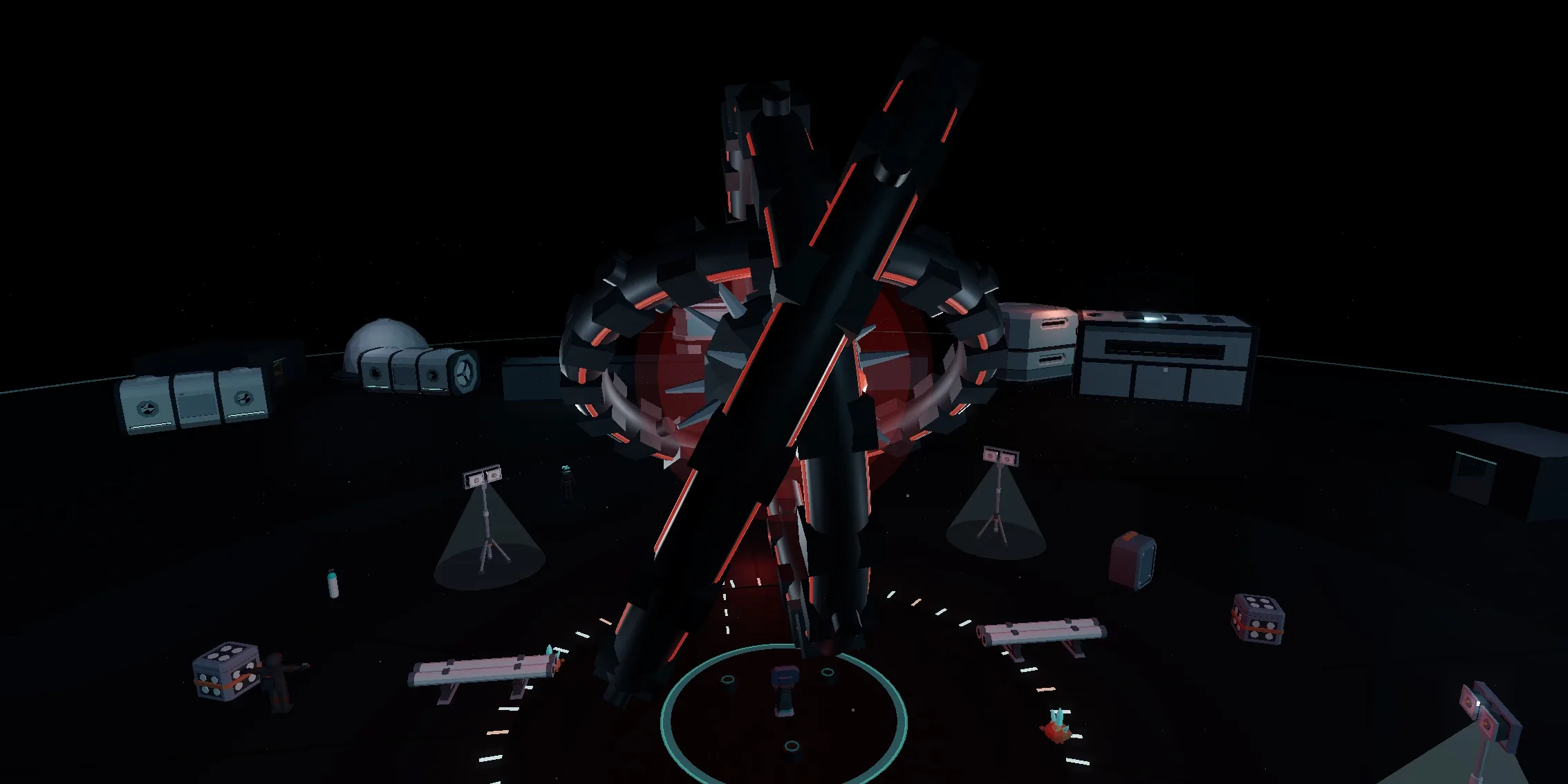
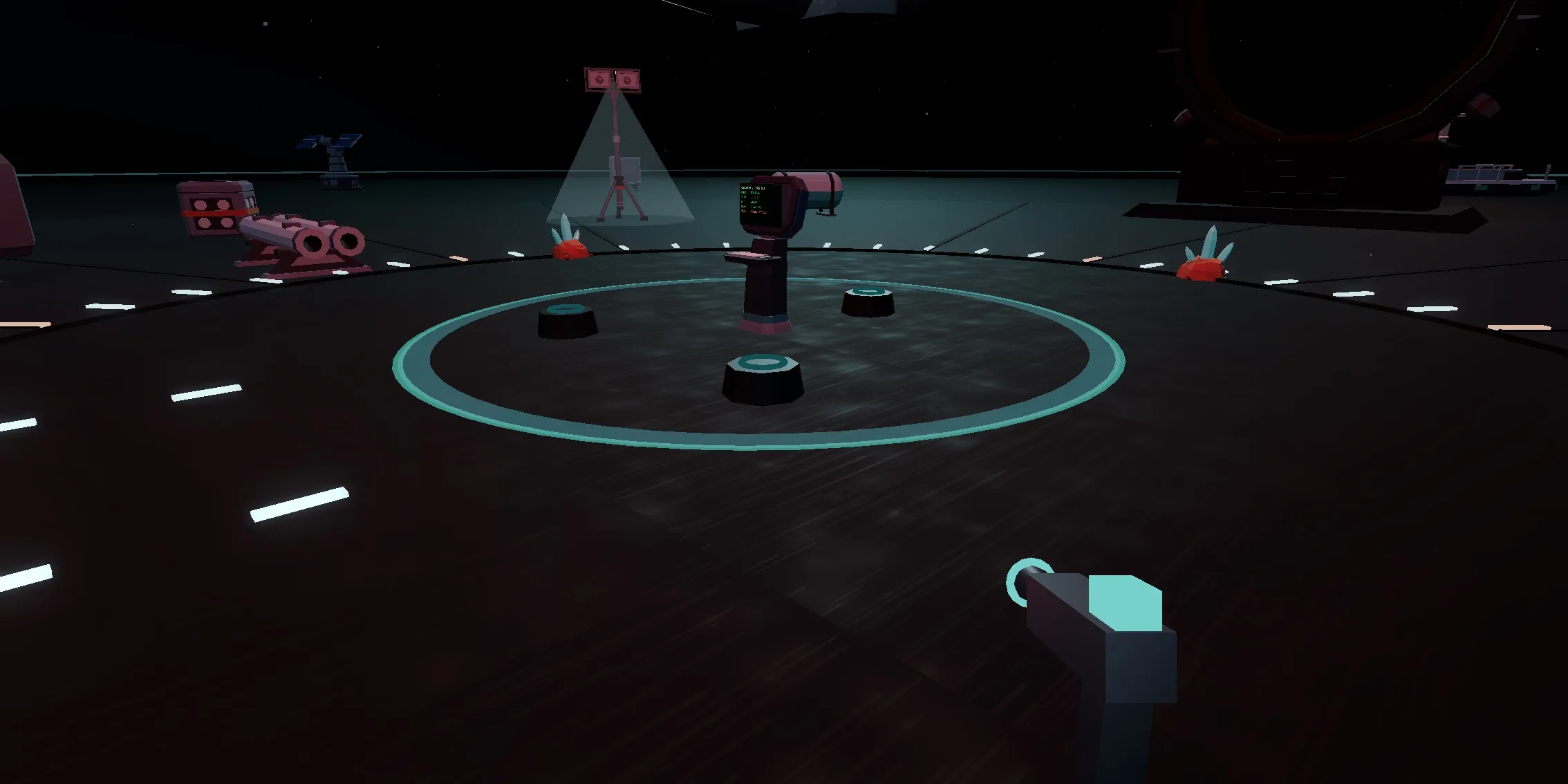
Directly under the core, at the centre of the bay, there is a marked circle on the deck about six and a half metres across, painted in two concentric rings: an outer band in the ship’s own cold utility colour and a thin inner line in the brighter guide teal that the nav arrow uses. In the game’s own code it is called the lip, and in everything the player reads it is called the platform. It is where you are asked to stand, and standing on it is the entire final act.
Set into it are three seats, arranged as a triangle at (-1.5, 1.4), (1.5, 1.4) and (0, -1.7). Each is a low pedestal with a torus ring on top and an unlit lamp inside it. Before you bring anything to them the rings are a dim, dead teal, and that dead teal is a promise the game does not keep.
Seating an interlock lights the ring, and it does not light it teal. It lights it in the wrong red, at full intensity, and the seat stays that colour for the rest of the game. Three cold teal circles becoming three hot red ones is the clearest statement the game makes about what you are actually doing when you close the door, and it makes it entirely in lighting.
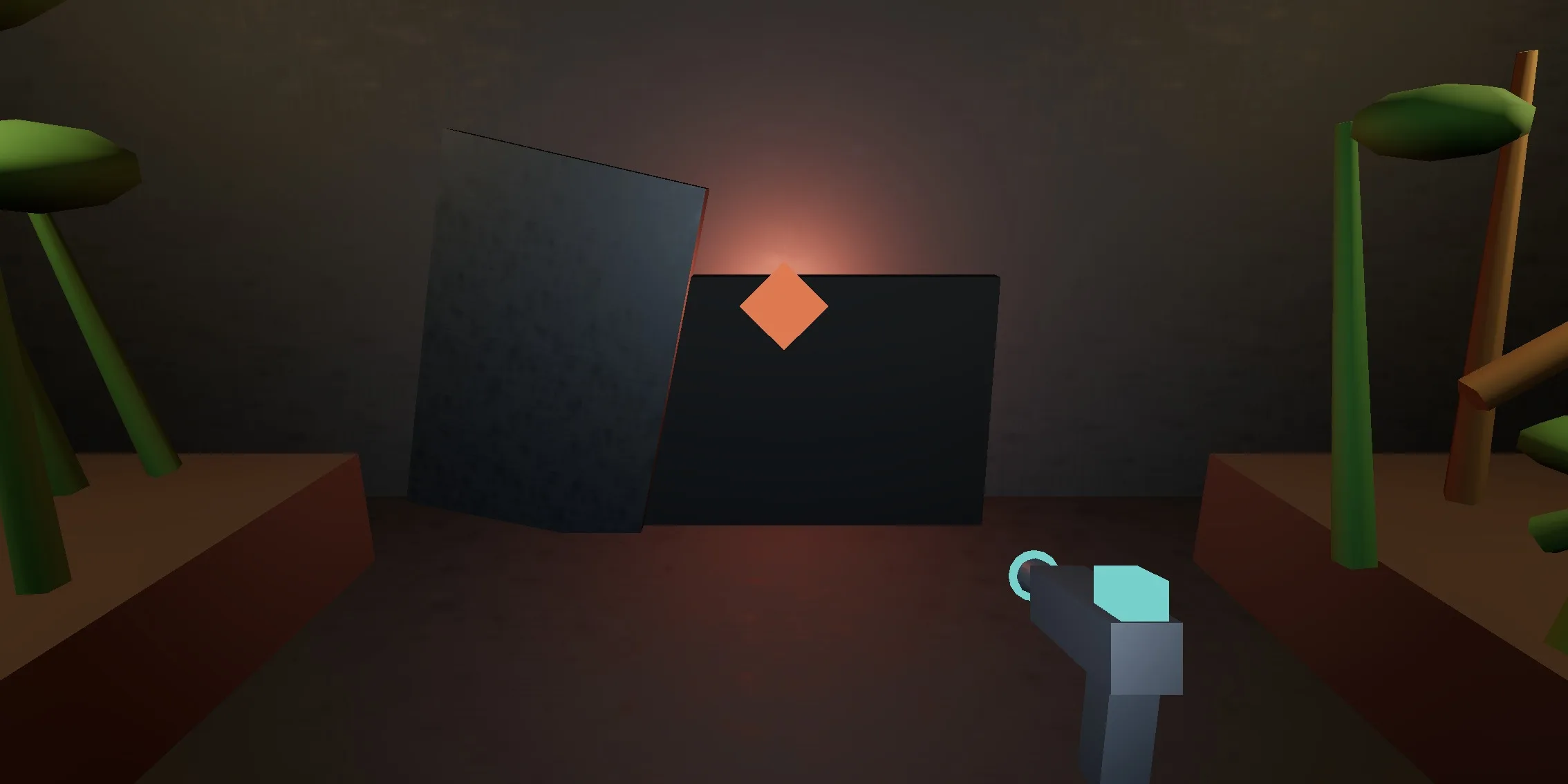
Three interlocks are needed and each one is sealed behind a welded steel panel in one of the three interior rooms described on the ship page. The panel is a plate about a metre and a half by two, in a frame, with four glowing weld lines across the seams and a red lamp above it, and it is the reason the salvage cutter exists.
Hold the beam on the seams. A panel needs three and a half seconds of continuous cut, against a cutter whose ten cells give you about four and a half seconds of beam before they are empty, so one panel is very close to one full charge and there is no room in the budget for aiming badly. If you stop, the progress you have made bleeds back off at about a quarter of the rate you put it on, which is generous enough to survive a flinch and mean enough to punish a pause. The cells refill after a second and a half of rest, and the emitter runs hot as you work: the charge cells and the tool’s accent ring both go from teal to red as the heat climbs.
The plate falls away and the lamp above it turns from the wrong red to a warm orange, which is the same warm the greenhouse work-lights use and the only other place in the game that colour appears. Inside there is a small turning octahedral shard, lit from within.
The panel is open. The interlock is inside. Somebody put it there. RYN, AT ANY OF THE THREE PANELS, ACT III
You carry one at a time and your hands are full while you do, so Act III is three round trips from the middle of the ship to its edge and back, and each trip ends with a ring coming up to speed behind you.
The line in the top left of the screen reports the drive and nothing else. It is the only piece of interface in the game that is not either a subtitle, an objective or a meter, and reading it back is a reasonable summary of the whole plot.
| READS | MEANS |
|---|---|
| DRIVE DORMANT | All three rings at rest. This is where the game opens and where it stays for two acts. |
| DRIVE SPINNING UP | Rings coming to speed. On the opening orbit camera you can do this yourself with the space bar, which is the game letting you play with the thing before it explains it. |
| INTERLOCKS 1 OF 3 SEATED | Act III, counting up as you work. |
| DRIVE AT SPEED · THE DOOR IS AWARE OF YOU | All three seated and all three at full rotation. There is no way back from this line. |
| THE APERTURE IS OPENING · 143 S | The sending is running, and that number is not decoration. See the sending page. |