SPOILERS. DON’T ANSWER THE HAIL. OPEN THE DOOR.
THERE ARE THREE OF THEM, NOT TWO
The design plan describes two endings, and for a long time the shipped game had two, because the sending could not actually be lost. That is no longer true. The sending now carries a deadline and three marks of air, and running out of either produces a third end card with its own name, its own score cue and its own last line. It is a loss, and the game treats it with exactly as much respect as it treats the other two.
| CARD | HOW YOU GET IT | SCORE |
|---|---|---|
| SENT TRUE | Finish all eight stanzas on the platform. | score_true |
| THE LINE STAYED OPEN | Lose the reading, to the clock or to the air. | score_pod |
| THE END OF THE ALTERNATE ENDING I | Take the escape pod, available from Act III onward. | score_pod |
SENT TRUE
The true ending · finish the reading
The eighth stanza is one word long, and when it lands the bay stops. Every crew member halts in the middle of a step, and the game is careful about why. They have not been beaten and you have not done anything to them. The instruction they were following has been withdrawn, and there is nothing left telling them what to do.
At the same moment the dark circle inside the gate goes to nothing. The Aperture does not close with a bang or a collapse. The thing that was too dark to be a picture of anything simply stops being darker than the room.
THE KEEPING
Then the game does the one genuinely gentle thing in its entire running time, and it does it for the ones you killed.
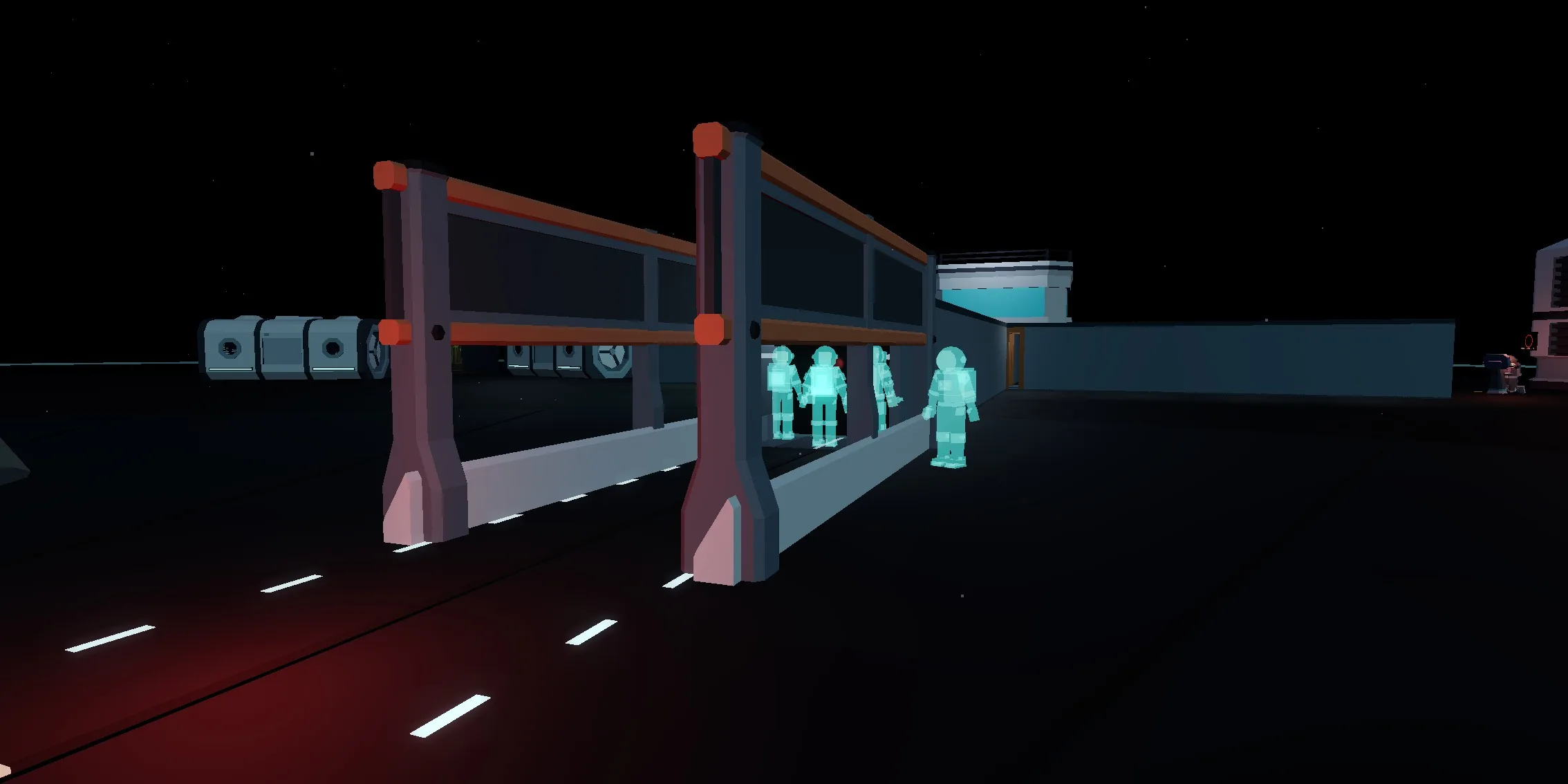
Every crew member you cut during the sending came apart into a cloud of drifting particles that settled on the deck and stayed there. Those clouds now reassemble. The suits come back out of their own dust as figures made of teal light, almost transparent at first, and over a few seconds they resolve into solid bodies again with their helmet lamps out. Teal, which in this ship has meant help and has meant CANTOR and has never once meant the crew.
And then all of them, the ones you cut and the ones you did not, turn and walk north up the spine toward the crew berths, spread out in a line rather than moving as one body, at an unhurried pace. They lie down in them.
Nothing you did during the sending is permanent. That is the argument the whole design has been making since Act II, when the cutter first refused to kill anybody: nothing you carry can end them, so nothing you do can be mistaken for solving them. The ending honours it by undoing the one exception it allowed you.
CANTOR
The camera then finds CANTOR, deliberately, and holds on him for his own shot. This was not always true: the line about his visor used to play over a camera pointed at empty deck, and he is now brought to the edge of the platform so that the last statement the game makes about its colour grammar is made while looking at the thing it is about.
Then the camera pulls up and away from the bay, the rings wind down, the three seats go out, and the last two lines land over a shot of an ordinary machine in an ordinary room.
Boone survives. She held at one kilometre exactly as she said she would in a transmission Ryn did not hear until six hours after it was sent. The game does not show you the pickup and does not need to.
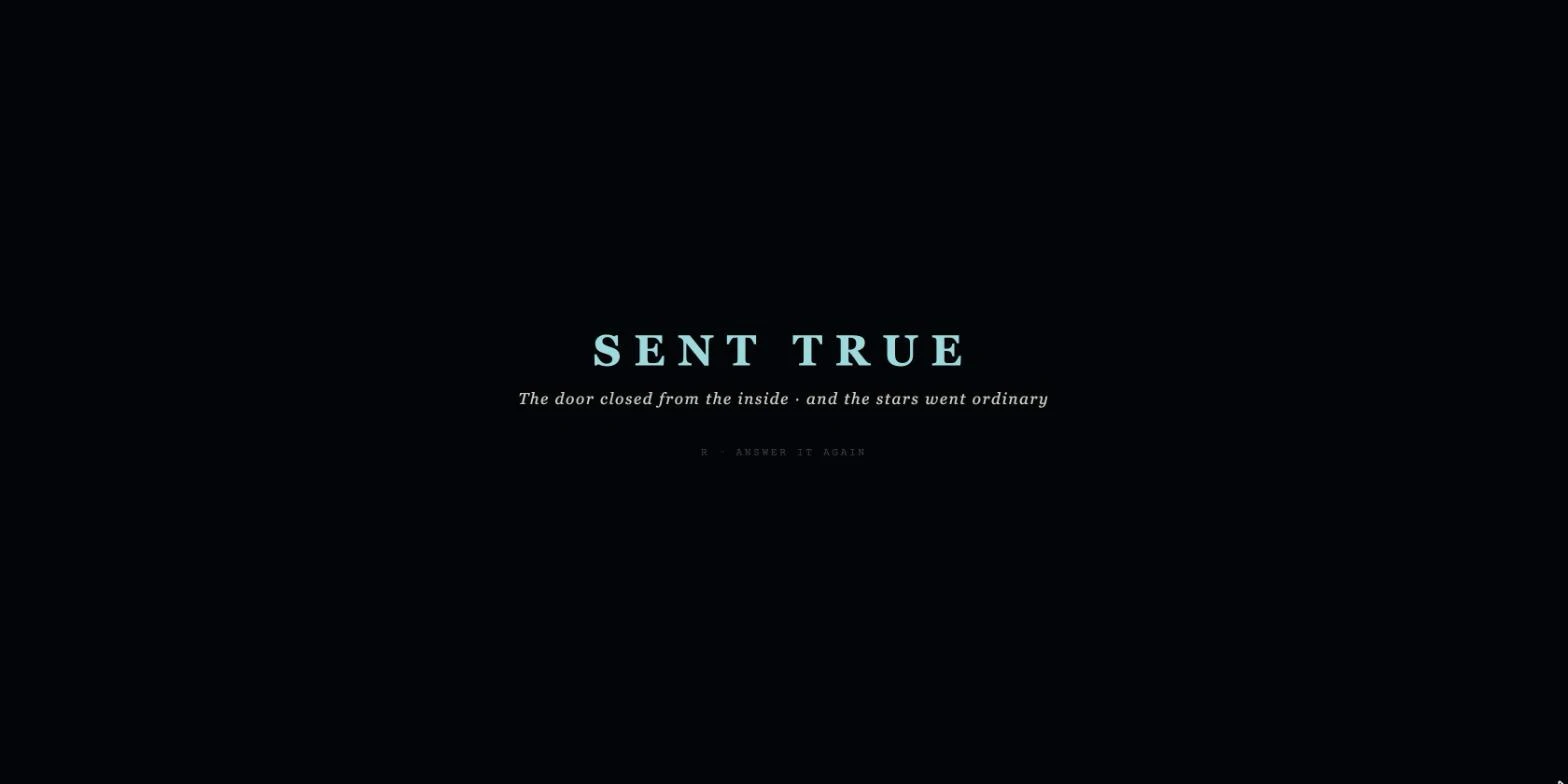
The cue underneath it is the only warm music the game contains: forty-six seconds of felt piano over strings, resolving to A major. Nothing else in the score resolves to anything.
THE LINE STAYED OPEN
The failure · the reading does not finish
There are two ways to arrive here and they are opposites. Either three marks of air are gone, or a hundred and seventy seconds have passed with the reading unfinished. Ryn has one line for each, and both of them are stated as facts rather than as cries.
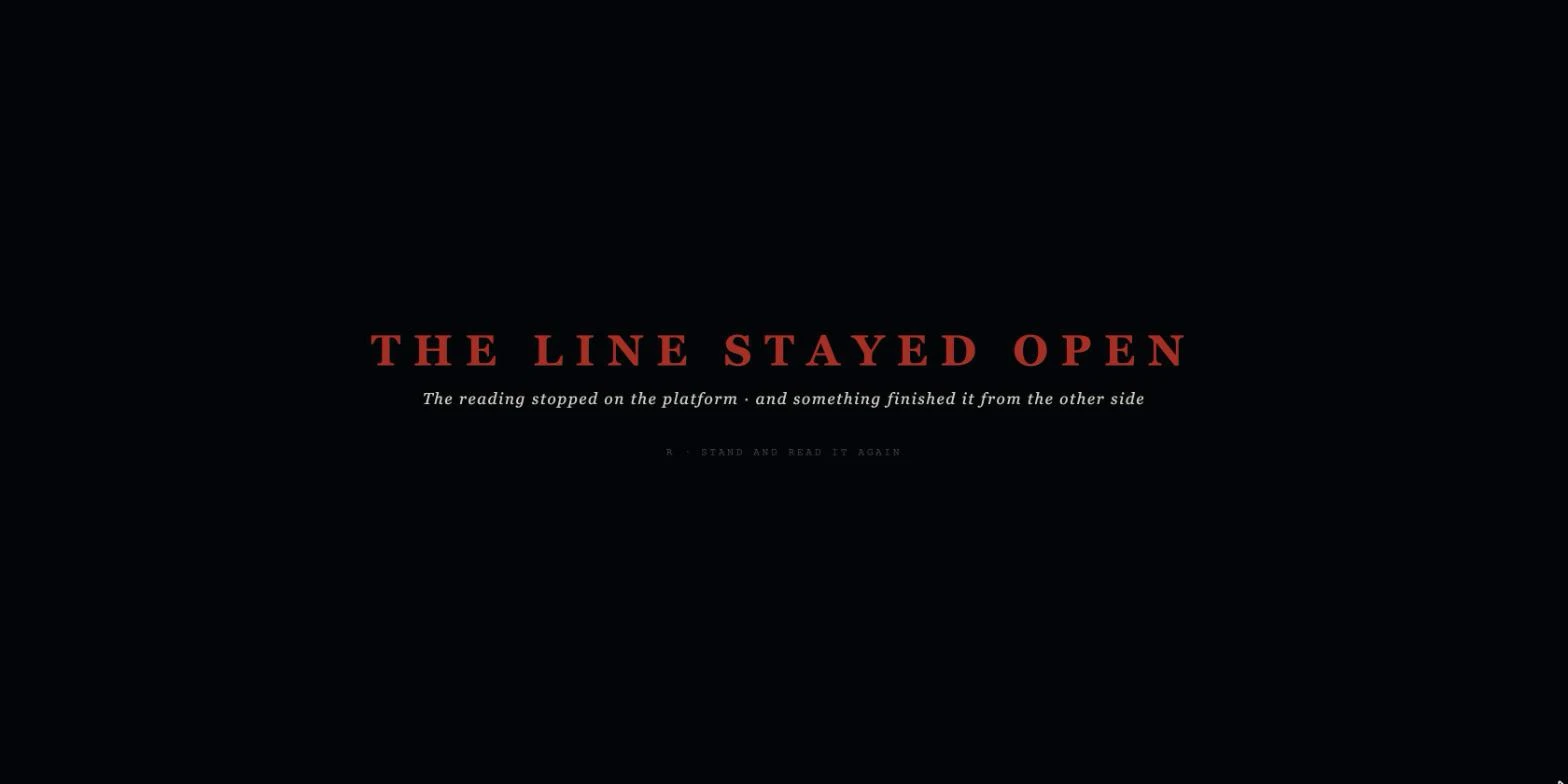
The crew stop where they are, the hull groans, the sending bar and the air meter both vanish, and the pod cue starts. Three and a half seconds later the card comes up, and it is the only end card in the game that describes something continuing rather than something concluding.
The subtitle is the whole ending and it is worth reading twice. The crossing is a sentence, and a sentence that has been started has to be finished by somebody. Ryn started it and stopped. The card does not say what finished it, or what the finished sentence did, and it does not have to, because the entire premise of the game is that a recording played is a door opened wider and the door was open when she stopped talking.
THE END OF THE ALTERNATE ENDING I
The alternate ending · take the pod
The escape pod stands on open deck at (33, -8), fuelled, from Act III onward. It is not hidden, it is not a secret, and it is not a trap in the sense of being punished for curiosity. It is a real way out, offered at the exact moment the player has learned enough to understand what taking it costs. That timing was a closed design decision, and the reasoning is on the record: offering it earlier would let a player leave before they knew what leaving cost, which is a worse choice to be given.
Ryn’s first line in the sequence is the best writing in the game about her, because it does not pretend the choice is stupid.
She is in debt. That is why she boarded, she said so in the first sentence of the game, and leaving means the debt is still there and so is she. It is an entirely defensible decision made by an adult with a clear view of her own circumstances.
Four seconds of burn. The Meridian shrinks in the window and looks quiet from out here, which it does, and which it is not. And then the third shot.
She answered the hail. That is the whole of it. She answered it in the first act by playing the log, she is answering it again now by carrying an antenna away from the ship, and the rule of the ship has never been about the Meridian. Every ship that answers becomes part of the antenna.
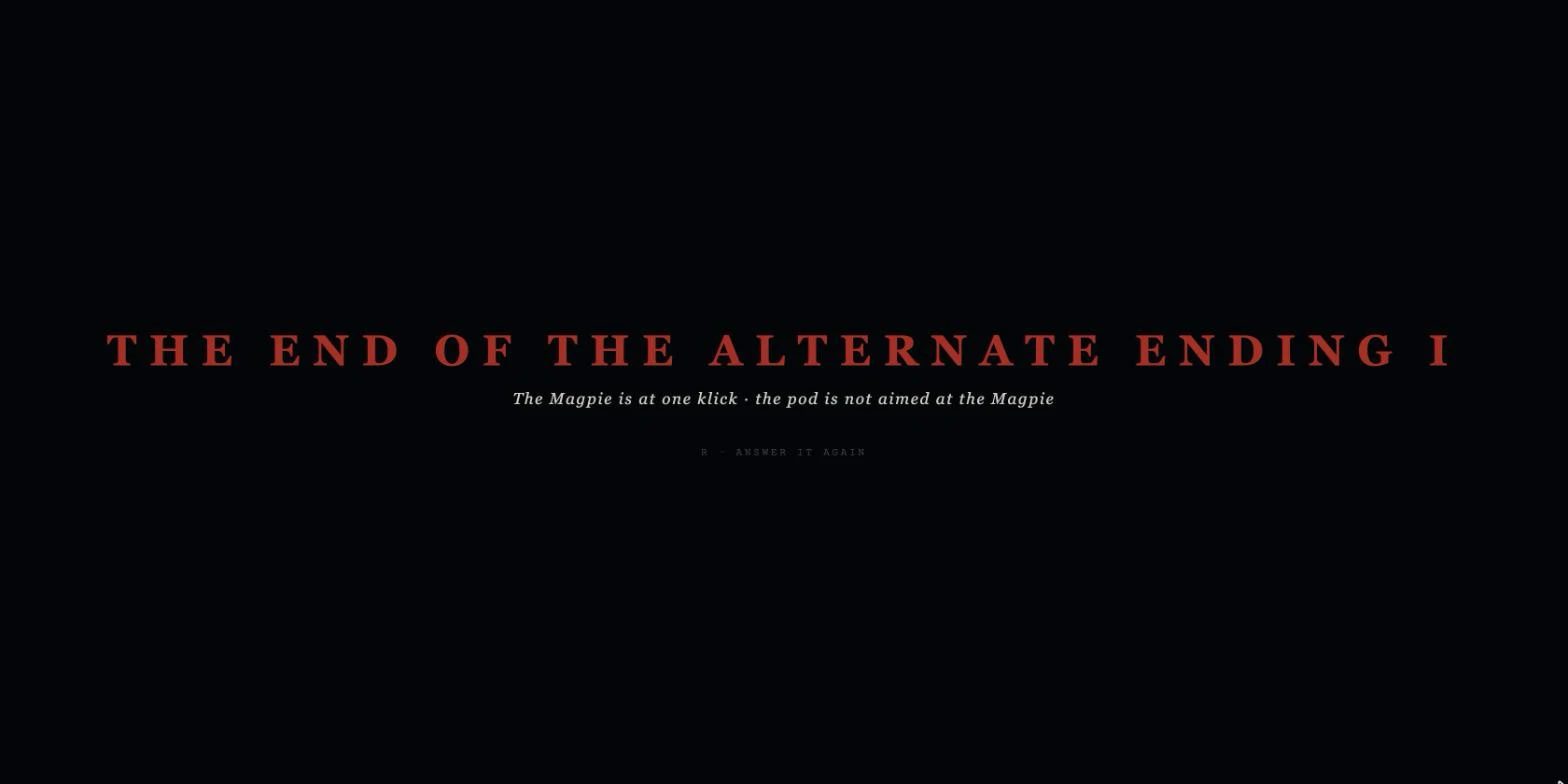
The card refuses to say the thing out loud, and that refusal is the point. The Magpie is at one kilometre with the real Boone aboard her, and Boone cut loose in the first place because the hail was already climbing her antenna. The pod is not aimed at the Magpie. The reader is left to do that arithmetic themselves, which is considerably worse than being told.
ALL THREE CARDS SAY THE SAME THING UNDERNEATH
Every end card in this game carries the same small grey line at the bottom, and it is not a restart prompt in the ordinary sense. It reads R · ANSWER IT AGAIN. Pressing R wipes the save and puts you back at the docking ring with the Magpie mated and Boone on the channel quoting salvage law, and the game is entirely aware of what it has just invited you to do.