SIX ENTRIES, EACH WITH A SHUTTER

The Crew

There is no bestiary page on this wiki, and its absence is deliberate. The game’s own writing rules end with an instruction that a bestiary would break simply by existing: the Returned are never called zombies, or deadites, or monsters. They are called the crew. So they sit on this page alongside Osei and CANTOR, as colleagues who are still at work.

Every entry below is open down to its shutter and closed underneath it. If you are partway through the game you can read the whole page above the shutters without learning anything the game has not already told you.

RYN CASTELLAN

The salvage technician, and the one who goes in

Ryn is the player, and she is a working technician rather than a hero. She is never seen. The only part of her that has any geometry at all is the salvage cutter, built from primitives and held low and to the right the way somebody carries a tool they expect to use rather than a weapon they expect to need.

Her reason for being aboard is money, and the game gives it to you in her very first sentence rather than saving it for a later revelation. She is deep enough in debt that a share of a recovered research vessel settles the whole of it, and she volunteers on those grounds. It is worth holding on to, because the game gives her exactly one opportunity to do that same arithmetic a second time.

RYN · THE FIRST LINE OF THE GAME
This is the salvage tug Magpie, mated to the research vessel Meridian. She has been lost for seven years. A full share of her clears what I owe, so I am the one going in.

Every line she speaks is spoken aloud, and her register is flat and short. She notices things in the order she encounters them and reports them without decorating them, and her fear shows up as her sentences getting shorter rather than as her voice getting louder. Reading the seven year old instruction not to do the thing she is about to do, she answers it with four words and a correction, and that is the whole of her.

We answered the hail, boss. That is what we did. RYN, AT THE LOG STATION, ACT I
THE DOCUMENTS AND THE GAME DISAGREE HERE The house style recorded in the game’s own polish notes asks for an explanatory register with no fragments, on the argument that a thought should be able to develop across two or three connected sentences. The shipped lines are flatter and shorter than that rule allows, and several of the best of them are fragments outright. Six trays. Five pushed back. One still sealed. The game wins, so this page describes the voice that actually shipped.
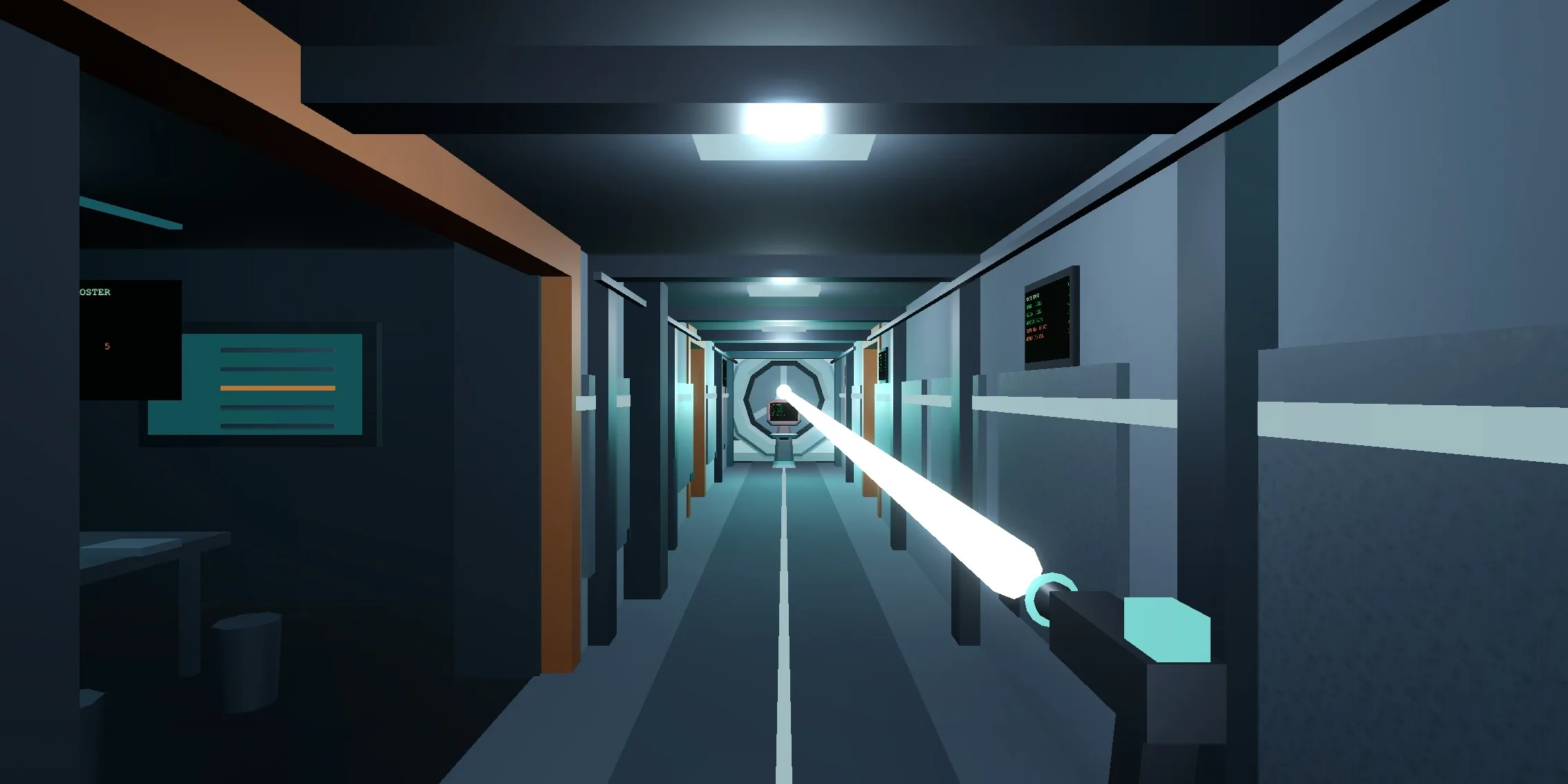
A first person view down the lit spine corridor. The salvage cutter is held low on the right with a teal accent ring at its muzzle, and a white beam runs from it to a hot bead of light at the far end of the corridor.
THE SALVAGE CUTTER · A TOOL FOR OPENING PANELS, CARRIED INTO A PLACE THAT NEEDED A WEAPON
WHAT SHE IS ACTUALLY FOR · ACT IV

The rule of the ship requires a living voice with no machine in the loop, which means the closing of the Aperture cannot be automated, delegated or triggered. Somebody has to stand on the platform and read. Ryn is the only living voice aboard from the reactor onward, so the entire structure of the game exists to deliver her to the one place where the thing she is is the thing that is needed.

She is also the only character who gets to choose. The escape pod is fuelled and available from Act III onward, and taking it is a real ending rather than a failure. The endings page covers what the choice costs in each direction.
IDRA BOONE

Captain of the tug Magpie, who never boards

Boone stays with her ship. She is the one who tells Ryn to answer the hail, on grounds that are entirely reasonable and entirely commercial, and she is a voice on the channel from before the boarding cutscene until well into the game.

She has no model. The asset manifest reserved a full-face character for her, and that asset never entered the game’s load list and no cutscene uses it, so no portrait of her can exist. That turns out to suit her, and this page gives her a channel rather than a photograph.

BOONE · BEFORE THE BOARDING
“Salvage law is very simple, Ryn. The first crew aboard owns her. Go and get me the flight data.”

There is one thing worth knowing before you open the shutter below, and it is a thing the game intends an attentive player to catch on their own. The real Boone talks like a captain. Listen to how she is talking to you as the game goes on.

SPOILER · THE LARGEST ONE ON THIS SITE · ACT III

This shutter is heavier than the others. A player who opens it early does not lose one moment, they lose sixty hours of retrospective unease, and the whole design of the middle of the game assumes they still have it.

Three interlocks seated, and Boone’s voice calls you back to the airlock to leave. CANTOR gets there first, stands in the doorway, refuses to move, and plays you the tug channel instead. The transmission he plays is six hours old, and in it the real Boone tells you that she cast off because the hail had started climbing her own antenna.

THE REAL BOONE · SIX HOURS AGO
“I had to cut loose. The hail was climbing my antenna. Close it from the inside, Ryn, and I will hold at one kilometre for you.”

The Magpie has been gone for six hours. Ryn has had sixty hours of Boone on that channel. The arithmetic is left entirely to her, and she does it out loud, twice, because the first time does not take.

Then who has been talking to me? Who has been talking to me? RYN, AT THE AIRLOCK, ACT III

What has been wearing her voice is on the Passenger entry below, and the tell is described there. Boone herself survives, holds at one kilometre, and is on the channel again at the end of the true ending, saying Ryn’s name like a question she is afraid to finish.

CHIEF OSEI

The Magpie’s engineer, who goes to fix the reactor

Osei boards with Ryn and splits off almost at once, on his own initiative and with a reasonable estimate, to get the Meridian’s power back. He is heard and not seen for the whole of the act that follows, which was a deliberate and recorded decision: hearing a man work for an entire act and then finding him does more than any earlier meeting could have done.

OSEI · ACT I, SPLITTING OFF
“I will take the reactor deck. Give me twenty minutes, and keep your channel open the whole time.”

He leaves a physical trail. Six weld-marks run west along the deck from the corridor junction toward the reactor block, fresh repairs laid down by somebody working their way along a route, and following them is how the game teaches you that the ship has routes in it at all. Through Act II his voice keeps reporting progress on the channel, always five more minutes, and the log stamps he reads out are seven years old.

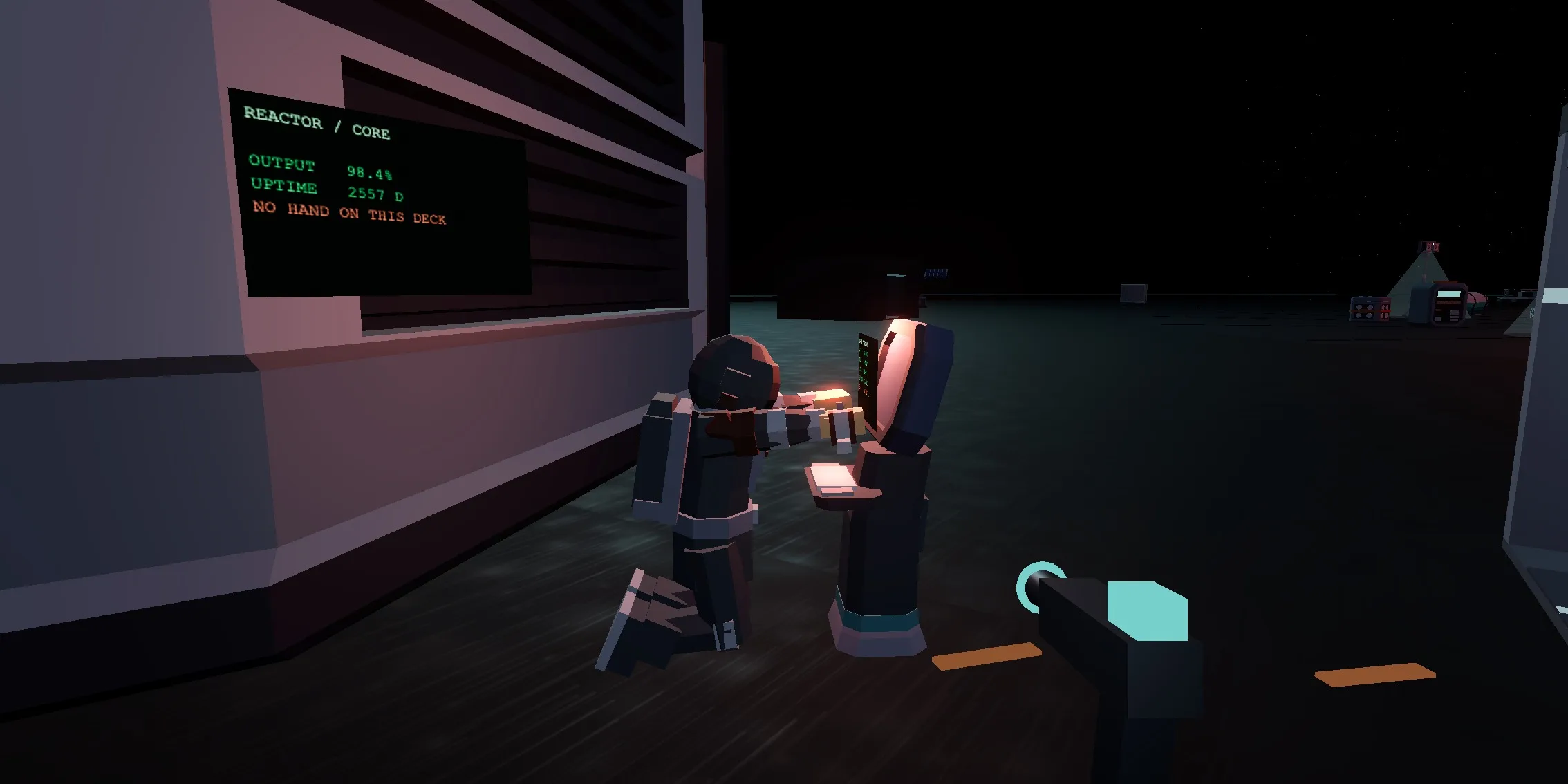
Osei kneels at the reactor console with both hands inside its open panel, lit from below by the warm light coming out of it. A wall screen behind him reads REACTOR / CORE, OUTPUT 98.4 per cent, UPTIME 2557 D, NO HAND ON THIS DECK.
THE REACTOR DECK, BEFORE THE CUTSCENE RUNS
SPOILER · WHAT IS AT THE REACTOR · ACT II

He is exactly where he said he would be, kneeling at the panel with both hands still inside it, and he does not look up. The tell is not his face, because you never see it. It is his boots.

RYN · AT THE REACTOR PANEL
The soles of his boots are worn through. He has been kneeling here for seven years.

The power comes back the moment she says his name, which she notices and declines to interpret. The Osei who boarded with her twenty minutes ago has been at that panel since before she was hired, which means the voice that has been giving her progress reports on the channel all act was never coming from the reactor deck. It was coming through CANTOR.

He is not resolved, revisited or avenged. He stays where he is for the rest of the game. In the true ending the crew walk to the berths and lie down in them, and he is not among the ones who walk.

CANTOR

The Meridian’s service robot, half of him still on the crew’s side

CANTOR is the most mechanically interesting character in the game, because he is not a character with a state, he is a state you learn to read. His visor is the entire ally system and it has two colours.

Teal means he is himself. He rolls ahead of you, marks the way, answers when you ask him something, and holds doors. He is the diegetic version of the nav arrow, and the arrow is teal for the same reason: in this ship, teal is the colour of the things that are helping you.

Red means something else is using his chassis as a speaker. Every mimic line in the game arrives through him in a borrowed voice, and the subtitle labels it honestly as coming through him. The episodes fire on their own timer, roughly every twenty to forty-five seconds, and each one lasts eight seconds, during which he stops, turns to face you, and the whole chassis floods.

CANTOR · ASKED FOR A HEADCOUNT, IN TEAL
“Six aboard. Six accounted for. All routes nominal.”

The rule that governs him is exact and worth carrying into the game with you. CANTOR never lies in text. He lies only in voices, and his own voice is teal only. Anything he says as himself is true, including the headcount above, which is true and is also the most alarming sentence in Act II once you understand who is being counted.

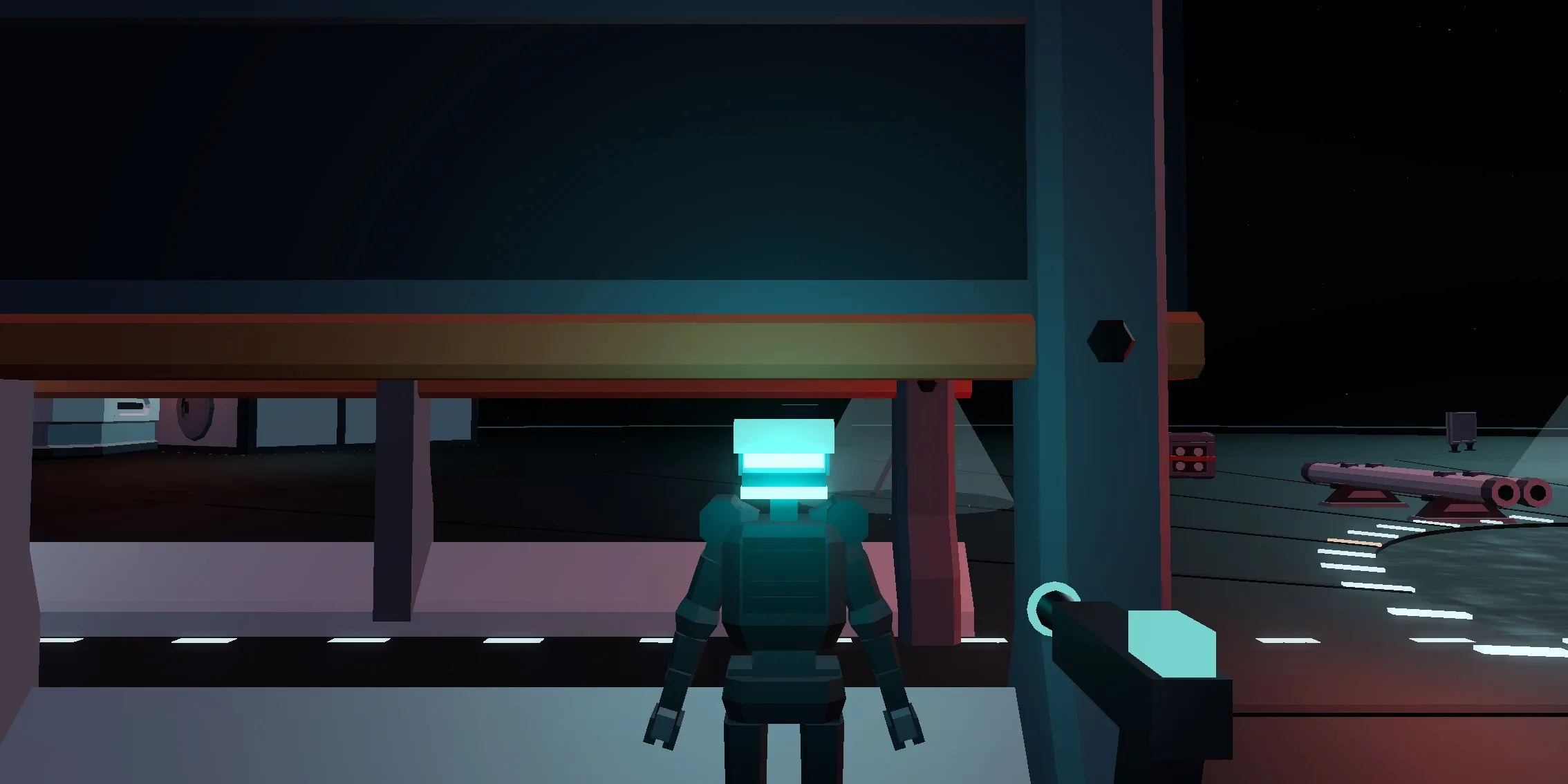
CANTOR stands about two and a half metres from the camera on the open deck, facing it. His visor is a bright teal bar, and the light from it falls on his own chest and shoulders.
TEAL · HE IS HIMSELF, AND HE IS HELPING
The same frame, unmoved. CANTOR's visor is now red, and the teal light has gone out of everything around him.
RED · SOMETHING ELSE IS TALKING, AND IT IS USING HIS SPEAKER
SPOILER · THE FIRST MIMIC, THE AIRLOCK, AND THE LAST SHOT OF HIM

His first red episode is not left to the timer. It is scripted to land on the third of Osei’s comms lines in Act II, so that the first labelled mimic in the game arrives inside a conversation you had already decided to trust.

THROUGH CANTOR · IN OSEI’S VOICE, ACT II
“Ryn, it is Osei. The reactor is perfectly fine. Come to the drive bay instead.”

The reactor is not perfectly fine, and the drive bay is not where she needs to be yet. Ryn works this out a corridor later, out loud, and it is the moment the colour becomes information rather than decoration: his visor went red back there, and the voice was not his.

At the airlock in Act III he does the bravest thing anyone does in the game. He physically blocks the door his own captain’s voice is calling you through, and he does it in teal, as himself, refusing an order he can hear is wrong.

His visor is teal. That means he is himself. He is himself and he will not let me through. RYN, AT THE AIRLOCK, ACT III
PREVIOUSLY A CONTRADICTION, NOW FIXED Earlier builds triggered a red episode underneath that line, so the chassis flooded red for eight seconds while Ryn described it as teal, which inverted the single most important signal in the game. The shipped build holds him teal through the whole cutscene. His visor never lies.

In the true ending the last thing the camera does before it leaves the deck is find him, and hold on him, and confirm the colour one final time. His visor is teal. It stays teal.

THE RETURNED

The Meridian’s crew, still at work

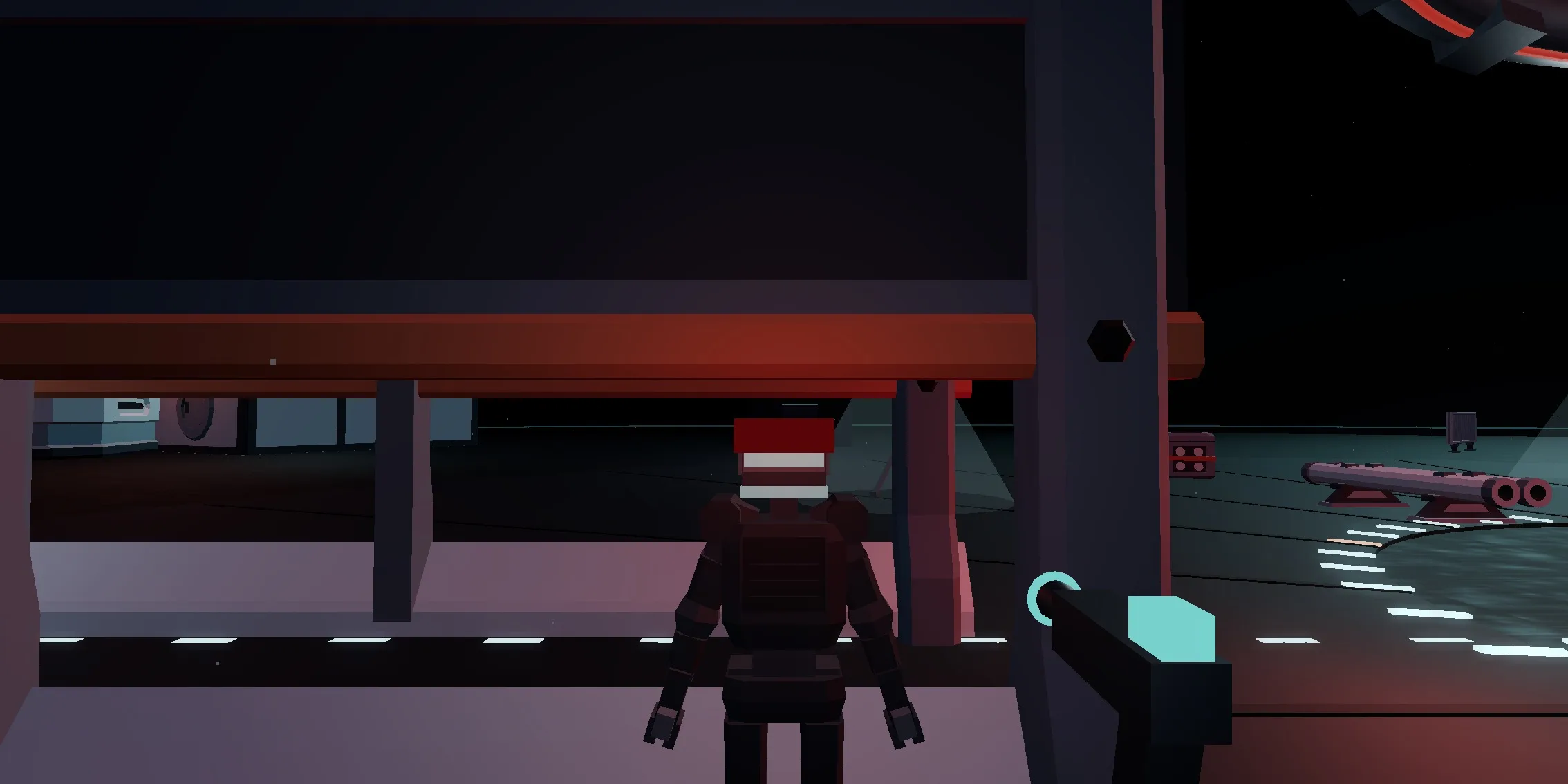
They are sealed in their suits, helmets dark, and the suit glow knob that should be the kit’s ordinary teal is burning a red that no manual lists. No skin is visible anywhere on them, which is both cheaper and considerably worse.

They do not hunt you. They maintain the ship. Five of them walk fixed routes in the shipped game, and the routes were laid out deliberately rather than at random: a wide round through the drive bay that every player will cross, the length of the spine corridor and back, the open west face of the habitat ring, the deck east of the reactor block, and the hangar apron. They pause on the way to tend consoles that have been dead for seven years.

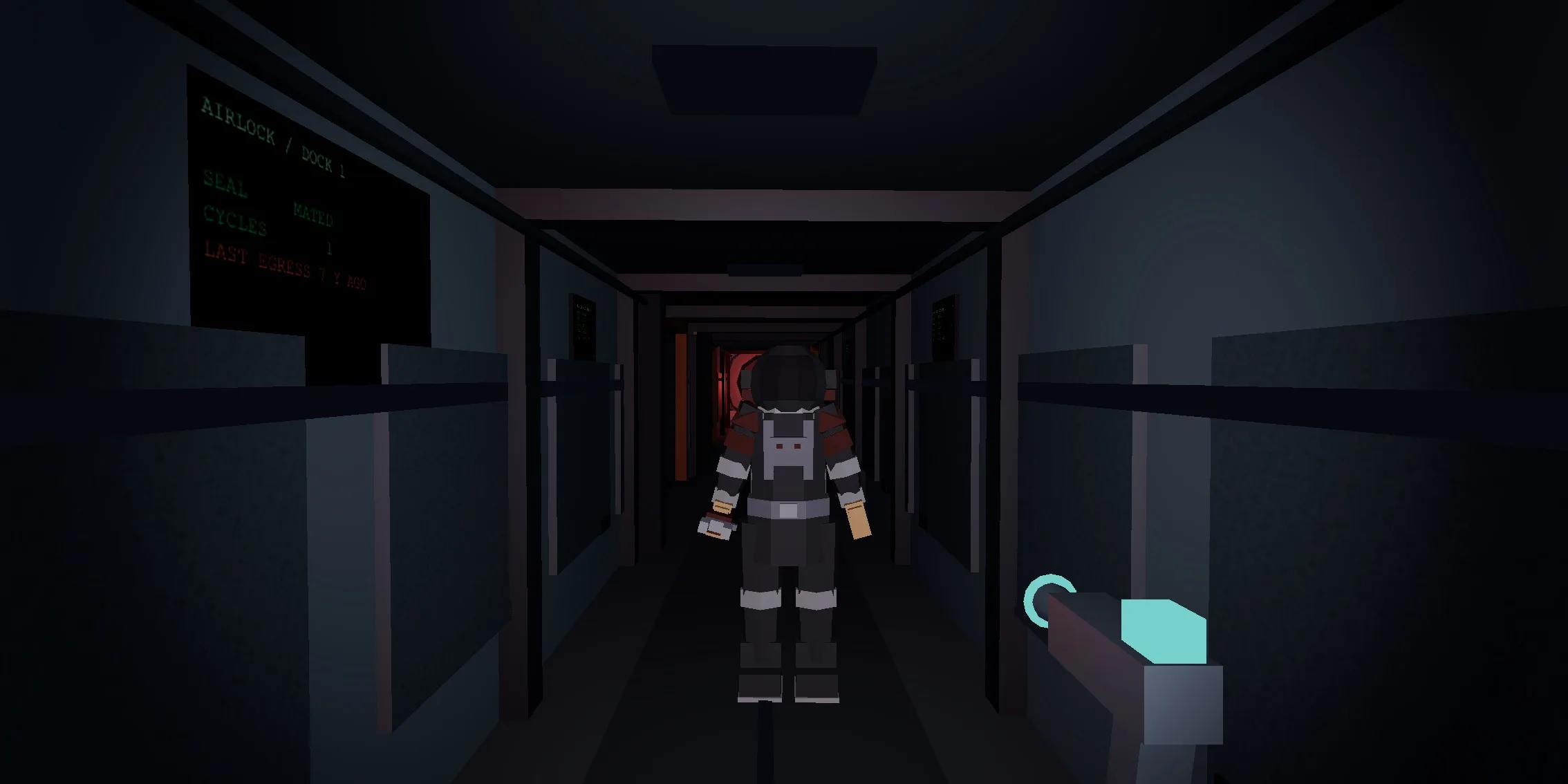
Their walk is upright and unhurried, and that is a decision rather than a limitation. Nothing in this game shambles. Within about four and a half metres one will stop, lift its head to a level gaze, and hold it on you until you leave.

A crew member in a suit standing four metres from the camera in the dark corridor, turned to face it with its head lifted to a level gaze. The airlock board is on the wall behind it.
IT HAS NOTICED. IT IS NOT COMING. IT IS WAITING FOR YOU TO GO.
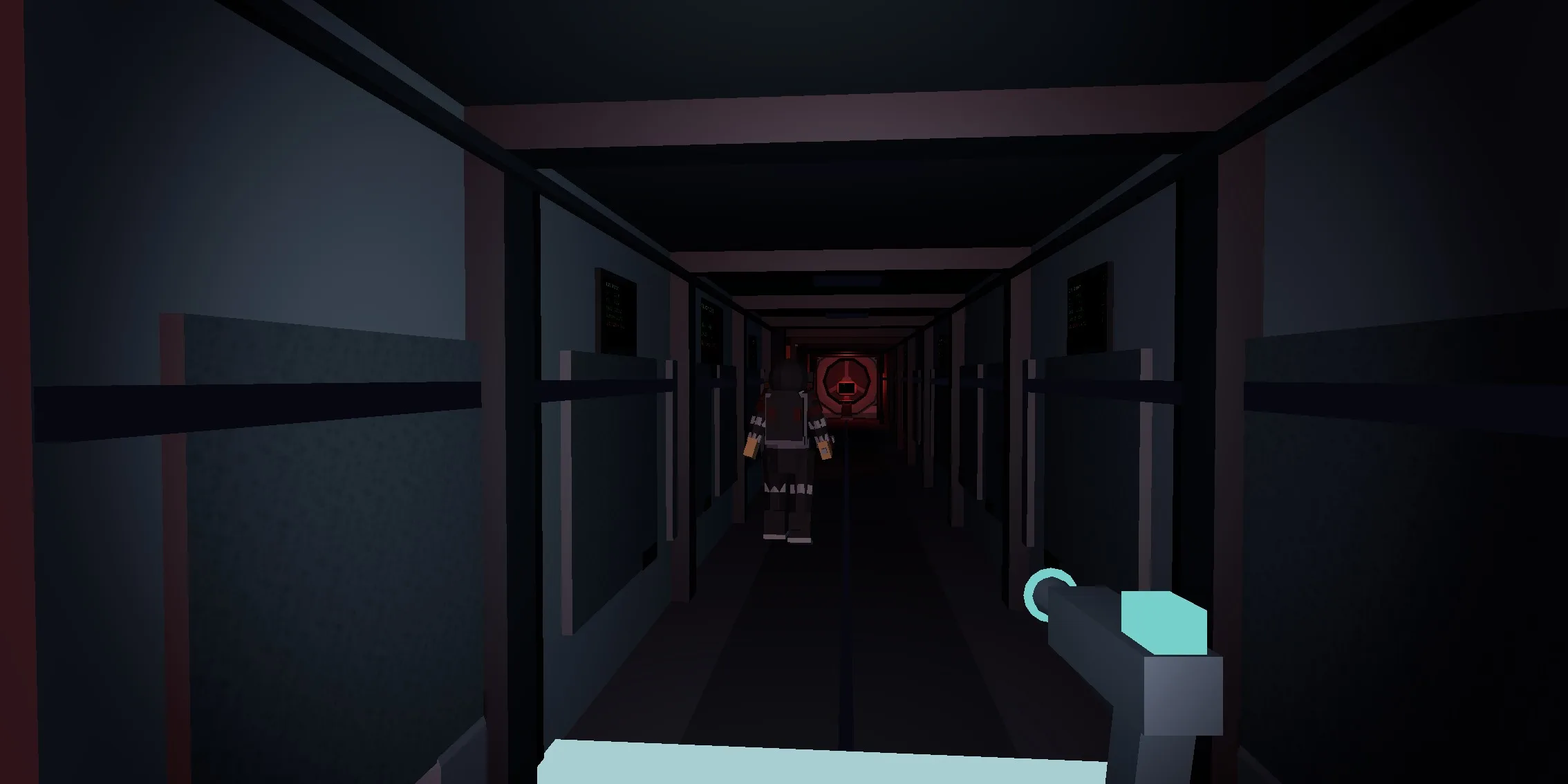
A crew member in a suit walking away up the dark spine corridor, caught mid-stride. The red beam of its helmet lamp lights the corridor ahead of it.
THE MAINTENANCE WALK · UPRIGHT, UNHURRIED, AND ON A SCHEDULE

The cutter staggers one for between ten and fourteen seconds and cannot kill it, and that limit is the design’s own argument rather than a balance figure. Nothing you carry can end them, so nothing you do can be mistaken for solving them.

SPOILER · WHAT THEY ARE COUNTING, AND WHAT BECOMES OF THEM

CANTOR’s headcount is six aboard, six accounted for, all routes nominal, and he is telling the truth. Five walking suits and Osei at the reactor is six. The galley duty board agrees with him and has agreed with him for seven years: seated six, trays returned five. One tray is still sealed on the table, because one member of the crew never came to dinner.

They converge on the platform during the sending, and they are not trying to kill you when they do it. They are maintaining a door that has been opened, which is their job, and you are standing in it. That is the entire hostility model of the game.

During the sending, and only during the sending, the cutter stops staggering them and starts unmaking them. A suit caught in the beam comes apart into a drifting cloud that settles and stays settled, and it does not get up. What happens to that dust afterwards is on the endings page, and it is the kindest thing in the game.

THE PASSENGER

What looked back through the Aperture and followed the recording home

It has no body, it is never shown, and this page is going to hold that line as firmly as the game does. Everything else about it sits behind the shutter.

SPOILER · ALMOST THE WHOLE ENTRY · ACTS III AND IV

You know it by its effects and never by its shape. Gravity leans. The screen takes a red vignette from the edges inward, the camera begins rolling slowly, and the dust in the drive bay stops falling and starts rising. That is the entire vocabulary, and the game never adds to it.

It is what has been on your comms channel. It learned Boone’s voice from the hail, and it has been using it on you for sixty hours. The tell was available the whole time and is described in the game’s own design notes: the real Boone talks like a captain, and the Passenger wearing her voice is one comma too patient. The voice takes make that literal, because her mimicked lines were generated at a higher stability and a slower speed than the real ones.

It crosses the drive bay twice during the sending, on the third stanza and on the sixth. Standing within three point four metres of the centre of the platform is the only shelter there is, and the reason is stated once and never repeated: it will not come near its own way out. The sending page has the timings.

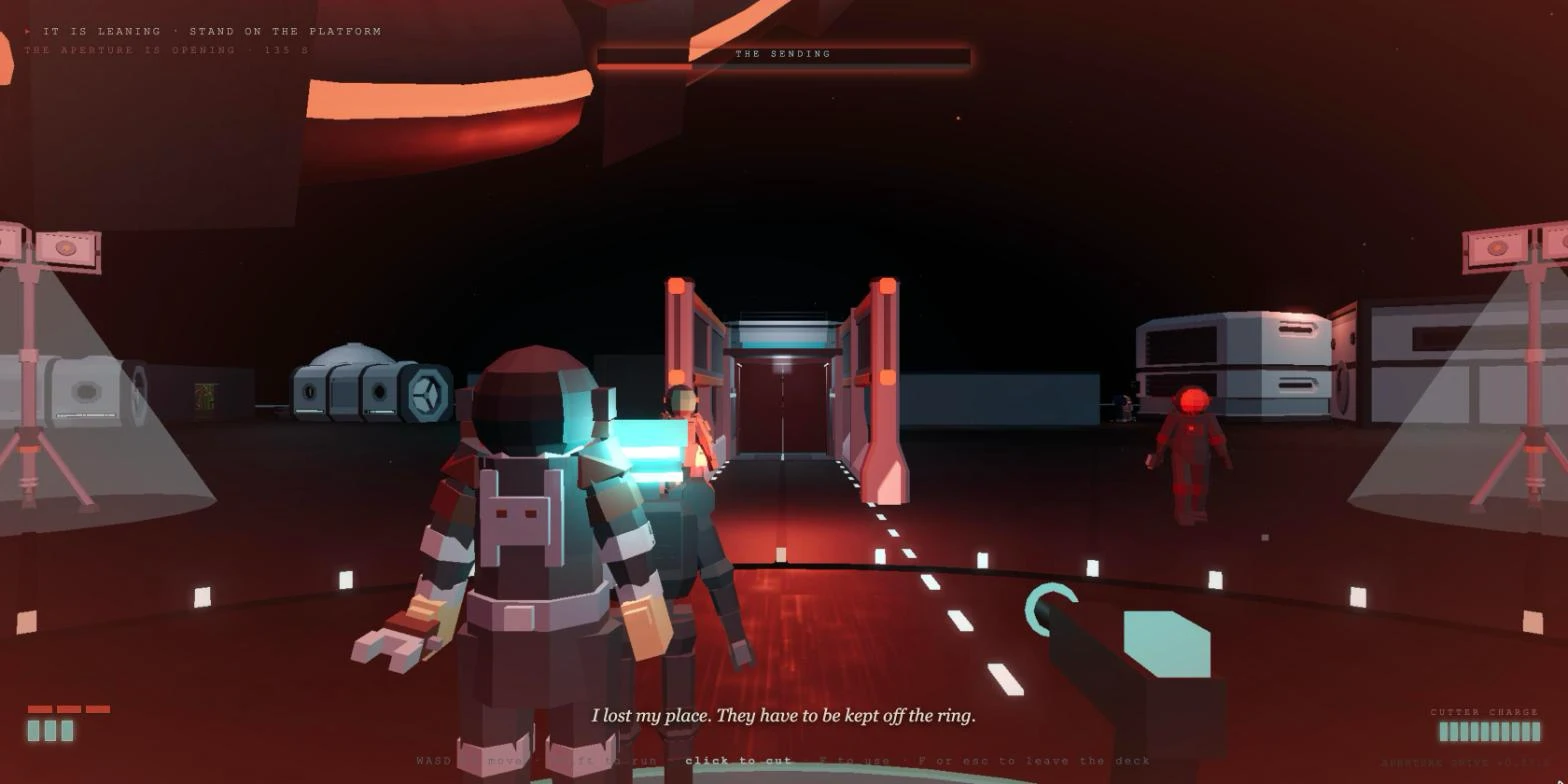
The whole screen washed red by the lean vignette. The objective line reads IT IS LEANING, STAND ON THE PLATFORM, the drive glows orange overhead, and two crew members stand close in front of the camera.
THERE IS NOTHING TO PHOTOGRAPH, WHICH IS THE ENTRY’S WHOLE POINT